Blog

The Woman Who Never Saw Mountains: Why I Travel

It’s written on my grandmother’s headstone that she never saw a mountain. My cousins interpret this epitaph metaphorically. They believe it means that my grandmother never saw an obstacle that she couldn’t overcome. 

I, however, know the phrase is very literal. My grandmother never saw a mountain. Literally. She also, to borrow a phrase from my mother, saw obstacles everywhere.

Long before she died, my grandmother had been obsessed with her epitaph. Her goal in life was simple: to be able to write on her headstone that she never, ever saw a mountain. The phrase resonated with her in a way that the usual identity markers — loving wife, devoted mother — didn’t. Her mountain-less state was the ultimate symbol of her singular determination to not do things: to mark her life by an absence rather than a gain. She’d refuse to go on vacations with my parents and I, lest we stray within the vantage point of a mountain or two. Even a trip over the border to Pennsylvania, rolling with Appalachians, Poconos, and Alleghenies, was out of the question.  

I doubt she ever left Ohio her entire life. (She may once have gone with us to Frankenmuth, Michigan’s Little Bavaria, but this would have been as close to a mountain — or to her family’s Germanic homeland — as she ever got.) She was born in Cleveland sometime in the 1910s. She was a child of the Great War, a teenager of the Depression, and a married wife, pregnant with her first child, during the Second World War. My grandfather stormed the beaches at Normandy. She stayed on the home front and birthed my mother. She spent two weeks in the summers at a rented cottage on Lake Erie. When her children were grown, she’d watch the dogs while our families went away on vacation. 

I adored my grandmother. She’s been gone for over 30 years and I still miss her. I wish she’d had more time to live out some of her other goals, like seeing all four of her grandchildren graduate from high school and go to college. But I don’t want to be her. 

*

In 2000, I realized just how far I’d come from my grandmother, both literally and metaphorically. I was on a flight from Rome to London, somewhere over the Alps on a cloudless November day. Below, the mountains cut through the earth in all directions, their snow caps so close that it seemed that, if they stretched just a little higher they could scratch the belly of the plane. I was mesmerized. I sat at my window seat, camera pressed to the glass, snapping through what remained of the film I’d taken to Rome.

I had just turned 21. I was spending a semester abroad in London and by that point in my life, I’d technically seen mountains before. I’d spied the Smoky Mountains from another airplane seat, and had driven through the foothills of the Alleghenies, but I’d never before laid eyes on what you’d call a proper mountain range, with rock and snow and crevices cut from where the melt drained. The sight was literally unlike anything I’d seen before. But beyond the stunning beauty, what fascinated me most was the fact that I was seeing something that my grandmother never had; just as she had marked her life by what she hadn’t seen, I was beginning to define mine by what I had.

Since then, I have spent whatever free time, and money, that I have traveling the world, to places my grandmother never imagined seeing. To be fair, I have far more advantages than she ever did. I live in a time where women have their own earning power, air travel is ubiquitous and (more) affordable, and the world more accessible to Americans than it was during much of my grandmother’s lifetime. I have options she never had, and, I suspect, never would have taken if she had.

I’m 43 years old and so far, have visited 38 countries and territories. I’m probably not going to get to every country in the world at this rate, but that’s okay. I tend to travel in batches, visiting one or maybe two countries at a time, rather than follow a more traditional backpacker’s schedule. I’ll be using this blog to share narrative essays of my journeys – many of which I’ve already taken, and which I will be writing about retrospectively from my memories and trip notes.

In some posts, however, I’ll be sharing narratives about trips as they happen. For my first posts, I’ll be writing about my adventures in Bosnia and Herzegovina – specifically, the cities of Sarajevo and Mostar — where I am through the first part of January. First post coming soon!

Fado: Alfama, Part 2

Okay, so it’s been a while since my last post – so long, in fact, that I am no longer in Lisbon! Alas, after my vacation I had to start right back to work, and the semester’s start has delayed my final vacation post.

But here it is, although not exactly contemporaneous to my visit…

One of the highlights of any trip to Lisbon – and to Alfama in particular – is a chance to hear fado, a style of vocal music that is emblematic of Portugal.

Fado – at least as I think of it – is kind of like a cross between flamenco vocalizations and the blues; it’s mournful, emotional, beautiful. It has its origins in Lisbon’s riverside neighborhoods such as Alfama, and was used as a vehicle through which to convey the woes of the urban poor and working class. Today, however, it is popular across all economic demographics as well as all over Portugal.

Still, purists will probably tell you that the best place to catch a fado performance is the atmospheric Alfama. These purists aren’t entirely incorrect. Alfama is peppered with fado bars, and with its narrow, frozen-in-time streets, it’s the perfect place to catch these haunting melodies.


IMG_1251
Performer at Club Fado in Alfama. Alas, my website does not support video links. 😦 


Fado venues vary throughout the neighborhood, from high-end clubs booking the biggest names to hole-in-the-wall joints where performances are local or even impromptu. Usually, the bigger clubs cater to tourists, and are found on main drags, while more local places are tucked away in Alfama’s labyrinth. When I first ventured to Lisbon four years ago, I found myself in one such place – which I would love to but could probably never find again – where performers sang open-mic style. I squeezed myself into a table, ordered green wine and olives, and just listened.

Whatever the club, bar, or hole in the wall, chances are wherever you catch fado, you’ll enjoy it. Personally, I’d love to return to Lisbon just to spend a few evenings bar-hopping among the different venues, but that’s a journey for another time.


Graffiti, Laundry, Fado: Alfama (Part 1)

DSC03533

On a small square in Alfama, against the side of a metal door someone had spray-painted the phrase “Tourist source of $, source of shit.”

The sign was both insulting and appropriate, given how touristy Alfama is. As one of Lisbon’s most authentic and picturesque neighborhoods, it’s packed with tourists like us ready to capture on camera every wrought-iron balcony, every house paneled in azulejo tiles. Like any major city, Lisbon has no shortage of graffiti but the Alfama neighborhood seemed especially hard-hit. A few days before, on our ascent to the castle, we’d passed through a narrow alley of ruined houses, many of which had been transformed into impromptu canvases for street art.

Those markings, however, I’d describe more as “art” than straight-up graffiti, which I’ll here define by its simplicity of design. (I’m not trying to weigh in on the art-vs-graffiti debate, merely suggesting that it takes more time and effort to design a Guernica-style mural than to spray words across a wall.) Much of the graffiti was more in keeping with the “tourism as shit” variety although perhaps not as extreme in its sentiment. I asked our guide, Joseph, what the purpose behind these frequent markings were. He scowled. “Stupidity. People are like dogs leaving marks.”

I’ve no doubt “marking” was a motive, although I’m less sold on the “stupidity” part. Sure, some of the marks were probably just – stupid, but “tourism as shit”, for its relative simplicity, may also have a more overt political meaning. That it was in English, and not Portuguese, gives some idea as to its intended audience.

I wrote earlier about how Alfama is one of my favorite neighborhoods in Lisbon but there is something dark and somewhat twisted behind Alfama’s charms. For centuries, Alfama was a district for the poor. The high, narrow houses packed tightly together, with charismatic laundry lines draped between balconies, were the refuge for multi-generations of immigrants, sailors, and religious minorities.

Today, Alfama is still associated with the economically poor and disenfranchised, although it’s also promoted as Lisbon’s most authentic neighborhood. Tourists are encouraged to lose themselves in the labyrinth of narrow lanes, the hole-in-the-wall restaurants, and the tiny bars where locals sip ginja (sweet cherry liquor, which I highly recommend) at all hours of the day.

To accommodate these tourists, other agents are now taking over the territory: beds and breakfasts, upscale restaurants, boutique shops and hotels. Tourism might bring in money, but it also brings with it gentrification. Alfama seems caught between the worlds that many American cities also in the process of gentrification are caught between: poverty and privilege, wealth and opportunity verses stagnation. As tourists, we come to view the charm, but we are also viewing this divide. We bring money, but we also bring change, and not always for the better or the benefit of everyone equally.

Near the end of our walking tour, Joseph took us to what he called a neighborhood laundry room. The room was on the ground floor of a white-washed house. Inside were rows of stone basins with faucets, separated by line after line of drying rugs and bedsheets. A few women mingled about, elbows deep in basins. Many who came here, Joseph said, worked for the beds and breakfasts, but some came to scrub rugs or other items they couldn’t wash easily at home.

Oddly and uncharacteristically for me, I didn’t take any pictures. I don’t know if these women were there cleaning their own dirty laundry or the laundry of others. Either way, the idea of recording their daily act of existence as part of my sight-seeing just didn’t appeal to me.

Belem, with rain and friends

If you’ve seen an image of Lisbon, chances are it’s of the Tower of Belem: a squat flourish of marble ornate as a candle sculpted from its own melting wax, docked along the Tejo estuary. It’s one of Lisbon’s most prominent – and photographed –  symbols, and fittingly so: it was once the first line of defense for the city, a fierce and flamboyant guardian.

(This is where I would insert a picture of the tower here, but … .)

For our trip to Belem, we didn’t see the tower because we didn’t want to. Maybe our lack of interest was due to the rain. Maybe all the miniature Towers of Belem we’d passed in souvenir shop windows spoiled our appetite for the real thing. Maybe, on its own, the tower just isn’t that impressive.

The real star of Belem, on the western edges of Lisbon, is the Mosterio dos Jeronimos, a UNESCO World Heritage site designed in the same Manueline style as the Tower, except a thousand times more impressive. You also don’t see quite as many knick knack versions of Jeronimos lining the windows of Lisbon, which might add to its charms.

But before we get to the monastery, I should probably write a bit about Belem’s other famous landmark, in honor of the foodies I am traveling with: Pasteis de Belem.


DSC03350
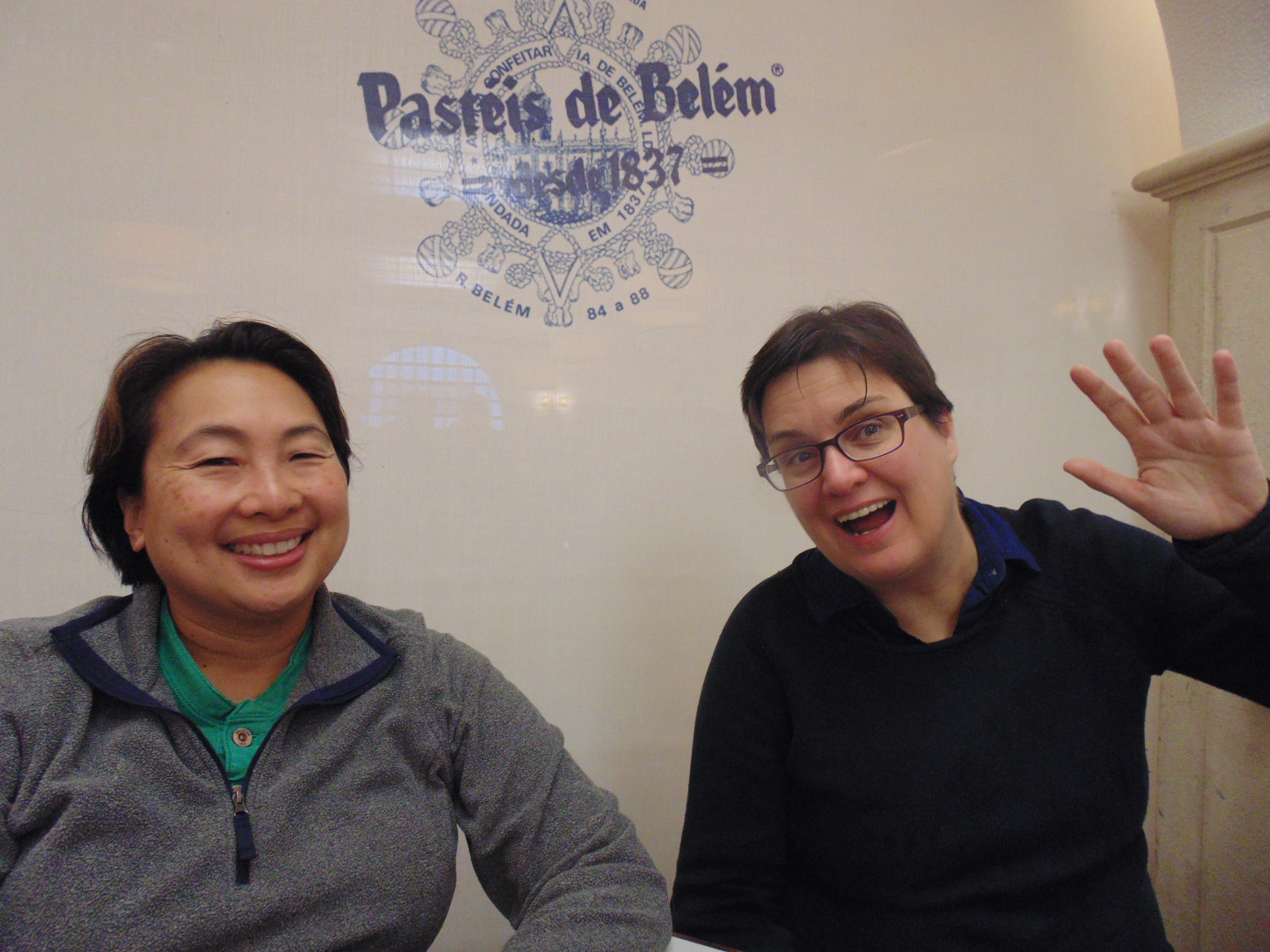
Johanna and friend, Melanie, at Pasteis de Belem


Established in 1837, Pasteis de Belem is so popular that on weekends lines for its delicacies might stretch for about three or four blocks. Back in August of 2014, when I had no choice but to visit Belem on a Sunday, the line for Pasteis had extended all the way to the monastery. Thus, I did not enjoy their famous pasteis de Belem, or custard tart, for which the cafe is so famous.

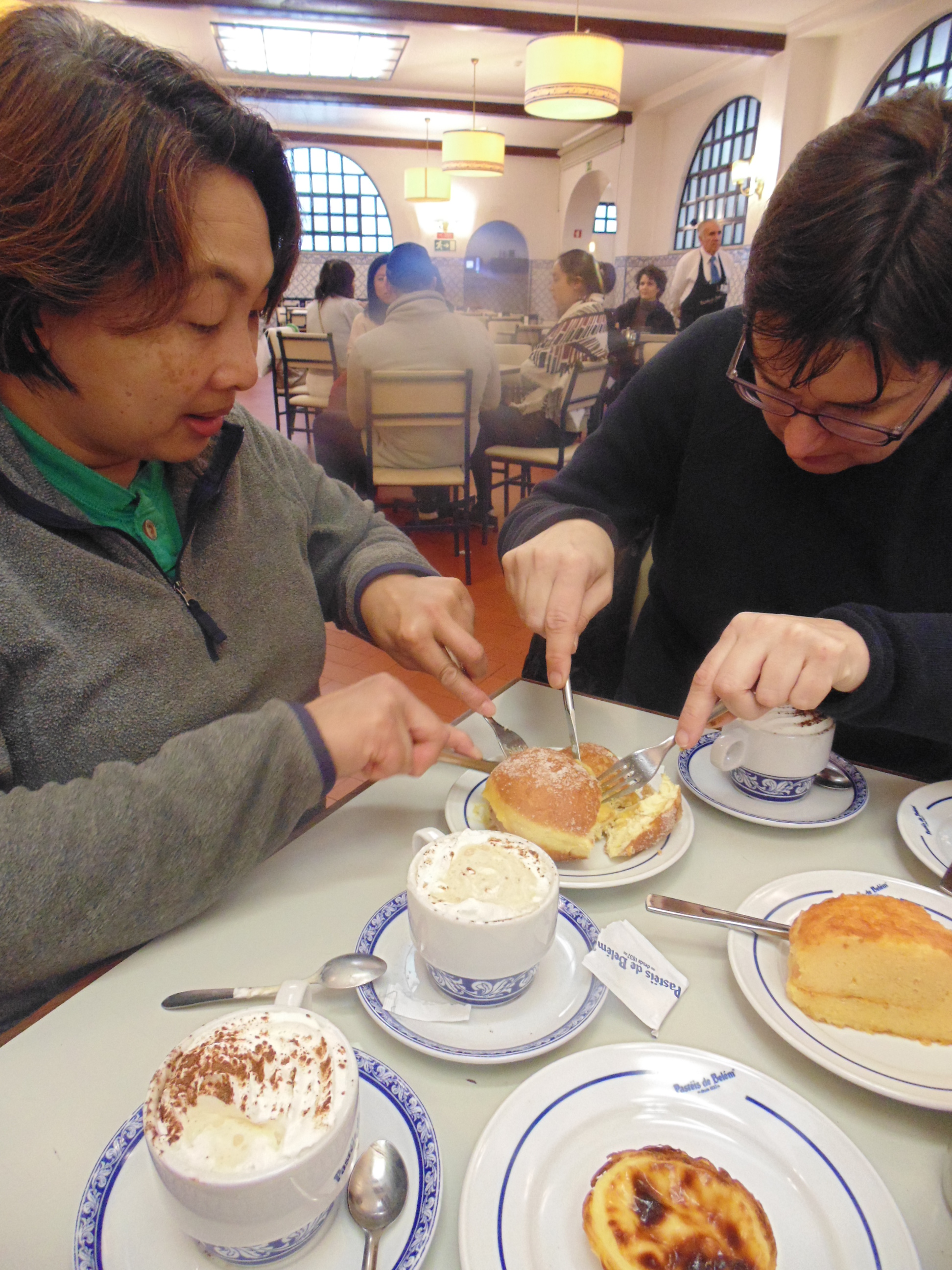
However, on a rainy Wednesday in January, tables were available for all. The cafe has a main bar, plus four rooms of tables which were nearly full by the time lunch rolled around. I went the traditional route and ordered a custard tart, although Johanna sampled something that looked and tasted like a spongy lemon cake AND something else that resembled a chocolate-gingerbread roll, while Melanie opted for a custard-plumped doughnut. (She would have ordered more goodies, but our waiter had some difficulty understanding that, although there were only three of us, we’d managed to order six pastries.)

The service was extremely slow, although our waiter was also quite friendly and helpful. Unfortunately, the notion of servers coming to your table only when you beckon them doesn’t work in a room filled with hungry and eager diners. However, the pastries and cappuccinos we ordered were delicious.


DSC03355
Various forms of yumminess 


For me, the highlight of Belem is the monastery, although I do want to take a few moments here to extol the virtues of the Centro Cultural de Belem, a modern plaza that includes a (free!) modern art museum. In a city where most tourists are drawn to the past, the museum offers a refreshing glimpse into the contemporary side of Portugal’s arty side. There’s also a nice sushi restaurant in the Centro, where three years ago I had a lovely lunch with proud Lisbon natives Juliette and Julio, who tried in vain to teach me Portuguese. (“It’s easy,” Juliette insisted. I wasn’t so certain.)

But since sushi isn’t exactly exotic delicacy for Westerns, we decided to skip the Centro and instead make Jeronimos our last stop in Belem. What makes the monastery, and also the Tower of Belem, so impressive is the architecture. Both are designed in the Manueline style unique to Portugal, a fusion of European and Asian elements resulting from the country’s conquest of the seas. Essentially, Manueline architecture looks a bit like what I described before, a candle ornately sculpted by its own melting wax (which is about as “technical” as I can get when it comes to describing architecture). The designs of this ornate carving were inspired also by Portugal’s seafaring adventures. Columns thick as redwoods and arches are vined by sailors’ ropes, while exotic beasts peer out from just about every available space.


DSC03377
Courtyard of Jeronimos monastery, in Manueline style


Jeronimos was founded in … okay, I won’t go into the history since most people visit just to see the spectacular architecture. Under blue skies, the monastery is truly breathtaking, and I’m afraid words can’t do it justice (therefore, see pictures, below).


DSC03388
Fancy arches with rope knots (or maybe they’re pretzels…)


DSC03390
Vaulted ceilings and details 


DSC03393
Through and arch, darkly. 


The rain, however, has its own magic, turning gargoyles into spontaneous fountains.

DSC03381

Stay tuned for my next post, which will not feature quite so many drooling gargoyles.